Rotates.org

June 15, 2009 - Mine’s bigger than yours

It’s been nearly 5 years since I upgraded my PC, and last week things came to a head when my creaking old system started wiping its own backup drive randomly. So, I set myself a budget of £1,000 and went to www.scan.co.uk and built up a machine. To cut a short story even shorter, I ended up getting the following spec:

  • Intel Core i7 920 (4 cores @ 2.66GHz)
  • 6GB of CAS7 RAM
  • GTX 275
  • 300GB WD VelociRaptor

And installed Windows 7 RC1 (which is absolutely fantastic – well done Microsoft, about bloody time!) on the whole caboodle. The results are highly pleasing – it can cope with the 21 megapixel raws I throw at it all day long now! The moral of this story is this: these days, you can get a hell of a machine for a lot less money than it used to cost.

Oh, and on an unrelated note… if you’re a web developer, you may want to check this out. I’ve created two sites with it now and I’m never going back to the old ways. This thing makes putting websites together lightning fast and the results are joyous in all browsers – yes, even IE6. Marvellous! Give it a go!

June 2, 2009 - The Krypton Refactor

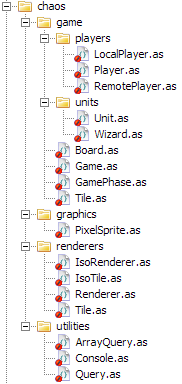
I’m sure it’s not just me, but I’ve found that sometimes some of the most difficult and profound decisions you make on a project only occur when you’re half way through writing it. It’s monumentally difficult to work out the specific heirachy of classes in advance (especially when you’re trying to write something modular) and sometimes you just have to write the damn thing before you realise where things actually should go!

The current project tree

The current project tree

So as I tapped away this afternoon, I realised I’d reached a critical point where I was starting to introduce messy hacks to send messages down and back up the chain of command undergoing several changes along the way – it’d stopped being efficient and had I gone any further with it, it’d have become a big nasty mess. At this point what’s needed is for some of the core classes (notably the game, board and renderers) to be refactored and reimplemented. Thankfully as it turns out this isn’t a large job (another huge benefit of observing OO best practices) and things will once again be going smoothly very soon.

Also, I have to thank each and every one of the people who’ve commented, emailed and otherwise shown interest in this project. It’s a great boost to the old morale to know it’s not only myself who’s excited about playing it! I’d like to take a few moments to clear up a few questions I’ve been asked:

  • Will there be a beta test? Can I be a tester? An online game is obviously going to require people to help iron out the bugs, and so yes, there will be phases of testing throughout the lifetime of the project (as new features get rolled out for instance – hint hint) and when that time comes, I’ll announce it. The iPhone version will be a different matter, as Apple are (understandably) tight about running code on other people’s devices. As such, when the iPhone version is ready to be beta tested, the only people who will be able to participate are those who have an iPhone development license themselves. Again, I’ll release more information about this at a later date.
  • How different will your remake be from the original? This is something I’m very conscious about – basically, Julian knew what he was doing when he created the original. It’s a formula that works through and through (obviously, as people are still playing it!) and I don’t want to tamper with it in any way. However I also see a lot of scope for expansion of the concept (though I might add not to the level of even Lords of Chaos, which I felt over-complicated the game somewhat) with the likes of new spells, new units and so on. It’s important that any changes I make are optional and modular – in fact ‘modular’ has become my mantra for the whole project. I’m by no means the authority on Chaos and its mechanics, and so I’ll leave such things open to tweaking.
  • Why isometric? It’s just so cool! Don’t worry though, there’ll be a traditional style renderer out of the box too!
  • Can I contribute? At this very precise moment, I’m afraid the answer’s no. My plan is to get the game into a playable and respectable state, and then make it open source. Besides I’d not wish to unleash my ghastly uncommented, undocumented alpha-quality code upon anyone else right now. I’ll make one exception however; if any talented pixel artists wish to update the original unit graphics (and maybe other graphics) then I’d be very interested in hearing from them. As nice and retro as the original sprites are (even the fettled ones I used for the old Flash version by Richard Phipps) I have a funny feeling that it’s only nostalgia that’s making them acceptable to current eyes…
  • What’s taking so long? Several things; my desire to get it absolutely right, my commitments to my real life job, my recent weekends spent in the company of my mates and my camera, my evenings spent watching Richard Dawkins on YouTube and working out a way I can apply all that evolution by natural selection stuff to the AI (I jest not!) and the occasional bout of Killing Floor or Left 4 Dead. Be assured this project is not about to disappear, I (hopefully) won’t suddenly be dragged away by ‘real life issues’ and my hard disks and backups won’t miraculously explode.

And now back to the music…

May 20, 2009 - The man speaks…

I finally managed to contact Julian Gollop after a bit of detective work, and his feedback has left me elated. They say never meet your childhood heroes, but I think for the first time that rule has proven to be incorrect – he’s an absolutely top bloke, and I have total respect for him.

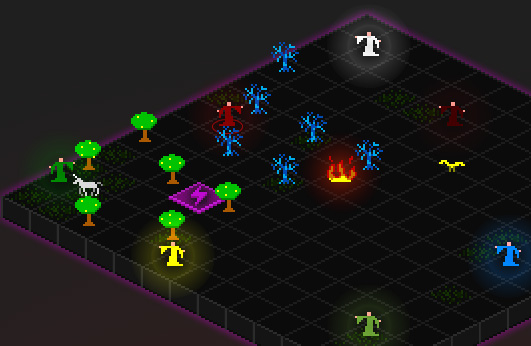
All of this of course means that I now have the answers I need, and the green light to really take this project somewhere very interesting indeed. I’ve not been very subtle or secretive, but for those who’re just tuning in, here’s a pic:

iBlob

May 16, 2009 - ArrayQuery

As I continue writing convienience classes for my Chaos project, I’ve put together something which (with a bit more testing) would be very handy for general AS3 development. It’s a simple to use class for querying an array of objects and returning the results as a new array. You can use it to recursively filter the objects by their properties until you have the ones left that you want – and yes I know about Array.filter but it’s much more usable and cleaner than that!. I’m using this to allow easy access to the units on the board (and I’ll more than likely be using it for the spells and other data structures in Chaos) – but as it’s a very universal piece of code, I think it deserves a place on its own. Keep your eyes peeled in the coming days!

May 13, 2009 - Persistence of vision

Last night I began to put a polish on the classes I’ve been labouring over for the past few months. The reason I’ve been labouring is that I’m trying to write this game in a way that makes netplay easy to implement. One of the biggest hang-ups has been on the role of a server in the whole thing, and how the data gets to and from it.

A big problem with HTTP and subsequently most of the technology designed around it is the lack of persistence. Simply put, when you visit a webpage, the server will fire up its processing engine, initialise all its variables and objects, read stuff from the database, process your request, then clean up after itself. This is fine for 99% of the things you’d do on the web, but when making a semi-realtime game run over this system, it becomes horrendously inefficient. By contrast, most games will load all the data into memory and it remains there in a persistent state, occasionally being altered by the course of the game.

So, if you want to make a game that runs online, you have an extra layer of complexity to think about in that you have to ‘serialize’ the game’s state into a format that can be sent over the internet to the server, then the server will ‘deserialize’ the data, process it, save it to its database, and serialize a response to send back. There are a few APIs available which handles these sort of operations quite well, but it’s still a complex thing to monitor.

Of course, you could do away with the server altogether (although this isn’t usually an option for a web app), or reduce its task to simply routing the data to wherever it needs to go. There are a few big problems to tackle with this however:

  1. Cheating – without a server, this means every client is doing its own verification of valid moves etc. Someone could fairly easily exploit this and send invalid moves.
  2. Synchronisation – with no centralised game state to reference, clients could get out of synchronisation.

The answer to both of these problems would be to perform validation on all the clients, so that everyone’s client would have to agree the move is valid within the context of their stored game states in order for it to be passed. This has its own problems of course, as it’s dependent on latency and consistency between client versions, and may make the game feel slow and laggy.

So after much deliberation about how to do it, I think I’ve finally found a way to handle server-driven games. The abstraction between the game data format and the renderer means that I have a very clean set of objects to represent games. By recreating this in C++ or Java on the server side, and using JSON to represent the objects and their properties as they’re transmitted from client to server and back again, I can build up a persistent remote version of the game on the server. Once a game is running, I don’t have to worry about storing and retrieving the data across requests, which eliminates much of the overhead. So the sequence of events that occurs when a Horse moves from tile A to tile B is as follows:

  1. The server tells all players that the game is in a movement phase, and tells player 1 it’s his turn
  2. Player 1 selects his Horse and tells it to move to tile B
  3. Player 1’s client works out the path to tile B (it’s more than one tile away so it requires the most efficient to be worked out)
  4. Happy with the path, the client sends the server some data, namely the player ID, unit ID and each step of the path in sequence. It also presumes the move to be correct and shows the updated position (this is called client prediction, and is very important in online gaming to produce a responsive interface – the chance a move will be legal will be many, many times more than the chance a move will not)
  5. The server receives the request and checks against its own version of the game to see if the unit can make this move legally; it double checks the path.
  6. Having verified the move is legal, the server sends back the player ID, unit ID and its final position.
  7. Player 1’s client receives the validated move.

Of course, if the move is invalid, the server will send back a rejection, with the player ID, unit ID and its original position as defined on the server. The client will then move the unit back and display an error. It should be noted that invalid moves will be next to unheard of as long as the server and clients are functioning correctly, and are there essentially to combat cheating.

Finally, to combat disconnections or to simply allow the game to be played over a long period of time and over multiple platforms, the server can send an entire representation of the game to the client to get it up to speed.

In closing, it’s a lot of effort to get a game to work over the internet, but it’s worth it to be able to live out that long held fantasy of playing Chaos with your mates – no matter where they are…


May 12, 2009 - Chaos Enhanced

I’m now officially on the war path with my Chaos remake; I’m chasing Julian Gollop, and I’m spending a lot of time planning the details of the server. It’s proving to be easily the largest and most complex project I’ve ever tackled by a huge margin, and so I want to get things right from the beginning, rather than turn the codebase into hacks supporting hacks.

As a result of the work I’ve been doing lately, I think it’s now safe to ‘release’ the unfinished, somewhat buggy original Flash version that I did a while back. It’s no indication on the way the new rewrite is going to look (the interface is as temporary as it gets, for instance) but it shows some of the ideas I’ve had – not least being the move to an isometric viewpoint.

Two turns in and it's already going nuts - ah I love Chaos!

Two turns in and it's already going nuts - ah I love Chaos!

Anyway, without further ado, here’s the link. There’s no real configuration, no multiplayer, and gooey blobs, magic fire and mounts can act decidedly strangely at times, and these bugs were the reason I abandoned this codebase – the main class alone had turned into a thousand lines of semi-procedural hacks!

April 28, 2009 - A new perspective upon new horizons

Well, I have to say I’m utterly blown away by the iPhone. I can quite solidly say it’s the most useful object I’ve ever bought – more useful even than my PC if I’m brutally honest. I’ve not put the thing down since I bought it; whether I’m checking my email, checking out websites in a proper browser on a proper screen, finding a takeaway in Barton-upon-Humber, playing Geo-defense or Wurdle while waiting for food in the takeaway, or even simply controlling iTunes on my PC from the familiar iPod interface via Remote (which has subsequently put Winamp on the back shelf – the first prog to do so since Sonique many moons ago) it’s been a complete and utter revelation.

This has obviously inspired me into developing for the iPhone – which means I need several things:

  1. A Mac – Oh dear. I shudder every time I have to turn to one of the studio Macs at work. Despite my new-found respect for Apple, Macs are still truly dreadful to use, primarily because of:
  2. OS X Leopard – It’s an improvement over the older versions, that much is true – however it’s also still basically an unproductive and annoying departure from what is obviously the ‘first choice’ way that Windows handles things. Apple can’t swallow their pride or dump on their existing userbase by conforming and as a result I can’t see Mac OS ever being their star product.
  3. XCode + SDKs – All 1.8gb of them. Yay!
  4. An iPhone developer account – Yes, Apple don’t allow you to run your own code on your own iPhone without paying them another £59. You can run it on the iPhone simulator that comes with the dev kit, but you obviously want to see and feel it on the real hardware (plus multi-touch with a mouse is out of the window).

As you can see this could become a pricey proposition. I’ve got something in mind for the first three steps – but it looks like there’s no way around the ‘Apple app tax’, I’ll simply have to stump up the cash.

The app that I have especially in mind is Chaos Enhanced (which now has a new name, though that’s for another post and an ‘official launch’) – which although being server-based and written in PHP with JSON I/O, needs client apps. If I can make the iPhone client smooth, slick and nice, then I can translate some of the features into the Flash client – I reckon this is easier and more likely to result in a really polished interface across the board, instead of me having to shoehorn the interface from a 1920×1400 browser window into an iPhone’s paltry 480×320.

On a rather unrelated note, I’ve also been looking at MooTools – partly because of the absolutely excellent Quakenet Webchat I discovered the other day which uses it, and partly because they’ve recently released a new version. Turns out it’s a really impressive looking framework, which takes an altogether more pure approach to extending and un-browser-fuckifying Javascript. I found myself absolutely hooked as I flicked through the docs and demos and I’m really excited about using it in my next Javascript project. Of particular note is its OO system, which I kinda envy and wish other languages I use (see AS3) had a similar system as opposed to the clunky, ugly and confusing Java/C++ way of doing it. I know I’ll attract hate with that statement but really, see how MooTools does it – it’s a breath of fresh air and makes total sense!

Finally, I’ve (attempted) contact with Julian Gollop regarding the ownership aspects of Chaos though I’m unsure as to whether I’ll get a reply – he appears to be a hard man to find. Hopefully I’ll get a reply, as a few things are resting on it at the moment. More news in the coming days on what’s going on with the game formerly known as Chaos Enhanced.

April 8, 2009 - iPhone finally

After several attempts to buy an iPhone off O2’s blatantly broken site I finally have one of these beautiful devices. Oh and I’m updating the blog from it as we speak! 🙂

Winnar!

Website and content © 2009–2026 Lewis Lane