Rotates.org

December 18, 2011 - Errors and actions

I’ve been getting into a routine of testing, re-writing and bolstering everything over the past week or two. This is in direct contrast to my usual routine of writing massive blocks of code without testing, then firing it up and watching it fail in multiple places, then lose the will to continue (something perhaps familiar to many developers) – so this time making sure every routine is working efficiently and giving me verbose feedback in every possible situation has been high on my priority list.

Tonight I implemented error codes and matching error messages – boring I know, but it’s just one of many steps I’ve taken to make sure I know when things aren’t working, and to make the client/server architecture as bullet-proof as possible. All this work at the front-end is to make sure that when the server’s launched, it’ll have a really easy to use API. One of my major goals after all is to make this an ‘open’ Chaos server, and invite front-end developers to produce their own ports for various platforms – indeed it should be very possible to write a front-end for a Spectrum using the same graphics, sounds and so on!

One of the other things I’ve implemented is a step-by-step list of actions for each game. The stored game data contains a current snapshot of the game, active players, unit positions etc – but it also now contains a blow-by-blow account of the entire game from when it’s created, as players join and then start playing. Clients will then be able to store a timestamp (returned from the server after each action they perform) and then put out polled or long-polled requests for updates from the server, quoting that timestamp. Once the server processes new actions, it can return those actions to the requesting client in the correct order (so for instance, if a player moves their wizard in the first turn, the server automatically advances to the next player as they no longer have any units to move – this logs two actions, a unit movement and then a “next user’s turn” action). Clients may choose to return actions from any timestamp, so as long as the client knows when it last got an update, it can always stay in sync. The client may also optionally request all the actions, in effect providing a way of replaying an entire game, or it can just request a ‘refresh’, which sends the client a snapshot of the game as it stands, with all the data it needs to resume the game from scratch.

Here’s an example of a typical update:

{

    "response": {
        "success": [
            {
                "id": 8,
                "action": {
                    "turn": 3,
                    "currentPlayer": 0
                },
                "time": 1324168638420
            },
            {
                "id": 9,
                "action": {
                    "moved": {
                        "id": "wizard_0",
                        "from": {
                            "x": 3,
                            "y": 5
                        },
                        "to": {
                            "x": 4,
                            "y": 5
                        }
                    }
                },
                "time": 1324168655828
            },
            {
                "id": 10,
                "action": {
                    "turn": 3,
                    "currentPlayer": 1
                },
                "time": 1324168655828
            }
        ]
    },
    "currentTime": 1324168722155

}

So far, I have a very solid base – board sizes and player counts are limitless and the server will automatically position wizards in a ‘Chaos-like’ arrangement around the board, regardless of size, shape or number of wizards, or at least up to 8 wizards, after that I need to write a routine to automatically space them – probably via some kind of circular distribution. Although spell casting isn’t yet implemented, units are and can be created by manually editing the game data – so I’ve had a wizard and his hydra happily moving around the board to my infinite satisfaction.

Next to be done is the combat routines – which will lead to the invariably sticky (though hopefully MUCH more manageable) death routine, which is always a bit of a pain with Chaos. Remember, some units die, some units disappear, some units (wizards) disappear and trigger a player defeated routine, blobs engulf, magic fire destroys outright and leaves no corpse, wizards on mounts if attacked by units lose their mount, but if overrun by magic fire disappear and trigger a player defeated routine and so on and on.

Plainly remaking Chaos is not as simple as it seems.
March 12, 2011 - Merry Christmas, happy new year and so on

First of all, apologies for not updating in yonks – I could give you the usual programmer excuses about real life, work and so on but you’ve heard them all before, so I’ll dive right in to what I’ve been doing:

Archaos is very, very slowly moving along – we’re talking geologically slow here, but nonetheless there’s still a roadmap and there’s still progress on it. My aim now is to have a release before my 30th birthday (next year) and I’ll be damned if I don’t make it!

I’ve been experimenting with presentation and so on, and came up with a little thing tonight which I thought was quite cute.  I’m really feeling the love for CSS3 and HTML5 now.

WordPress has become my new powerhouse tool at work, and I’ve been churning out sites left, right and centre in this wonderful blog engine turned CMS (as of 3.1 especially so) – check out some of the following:

The last is our most recent project, and is very much not a site you’d expect to be WordPress powered – such is its flexibility!

I don’t update on Twitter much anymore, as it’s become a bit of a joke now with all of the celebrities and ridiculous trends; it pains me to say it but I think Twitter is more about Justin Bieber now than anything sensible. Alas, I spend most of my social networking time now on Facebook.

Finally, I’ve booked a flight to Arizona in September for a two week photography road trip with two of my good friends – should be awesome!

Anyway, hopefully that’s got everyone up to speed on what I’m doing – keep your eyes peeled in the coming months for updates on Archaos and other projects.

January 17, 2010 - Chaos Enhanced Enhanced

As another little aside, I’ve hacked in some configuration for Chaos Enhanced. Use the form below to launch a game with your desired settings – though please note that this is an abandoned demo with missing features and bugs!


Forgive the awful form and jQuery... it was quick!

January 16, 2010 - Full cycle

The Archaos server now validates, processes and outputs a full turn of human interactions. This is a pretty major milestone in the development process, and I’m very happy with the results so far:

{
  "turn" : 1,
  "phase" : "move",
  "interaction" : "sequence",
  "finished" : true,
  "actions" : [
    {
      "type" : "move",
      "player" : "lewster32",
      "time" : 1263682234,
      "data" : {
        "piece" : "p0",
        "path" : [
          {
            "x" : 1,
            "y" : 7
          }
        ]
      }
    },
    {
      "type" : "end_turn",
      "player" : "lewster32",
      "time" : 1263682234
    },
    {
      "type" : "move",
      "player" : "bobster16",
      "time" : 1263682234,
      "data" : {
        "piece" : "p1",
        "path" : [
          {
            "x" : 13,
            "y" : 5
          }
        ]
      }
    },
    {
      "type" : "move",
      "player" : "bobster16",
      "time" : 1263682234,
      "data" : {
        "piece" : "p3",
        "path" : {
          "x" : 11,
          "y" : 4
        },
        "flying" : true
      }
    },
    {
      "type" : "end_turn",
      "player" : "bobster16",
      "time" : 1263682234
    }
  ]
}

I’d like to mention the huge amount of support, encouragement and fantastic resources provided by certain people of late. @andy_herbert has been a fantastic vocal advocate and provider of much inspiration and technical knowhow (he’s an utterly brilliant multi-talented programmer in his own right) and I owe an awful lot to his ‘cheery’ tone on Twitter! 😉

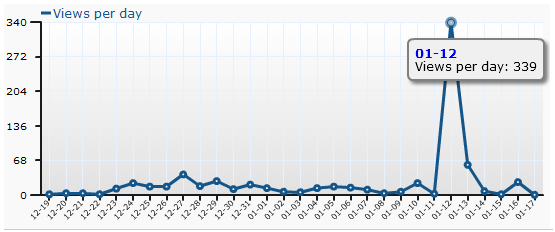
Secondly, I’d like to shout out a big hello to the Slashdot horde, who accosted the site a few days back. I got a hell of a lot of visits from these guys and I’m sure it’s helped spread the word about Archaos (even if that wasn’t actually my intention) and more importantly the Chaos scene in general!

Finally, a big thanks to @Zolyx for mentioning the project on his blog along with the other fantastic Chaos projects out there – muchos appreciated!

January 10, 2010 - nodelog IRC bot

As a little bit of an aside to ‘the main project’ , I’ve been getting more familiar with node.js by forking a nice simple IRC bot project on github. At the moment I’ve just got it logging in an mIRC compatible format, and added some missing features to the logging, but in the future I’m going to extend it into a proper modular IRC bot.

January 4, 2010 - Non techies avert your eyes

The server is really starting to take shape now. Turns and phases flow along nicely, and I’ve spent the last few days working on the spellcasting system. If you’ve read the Google Code page on Spells you’ll know that the spells themselves are simply sandboxed Javascript functions. I had thoughts before about writing some kind of scripting language for the spells because I wanted maximum flexibility, but it dawned on me that simply giving the spells access to the game and board data themselves in the native language would be the best way to do it. I also not long after that thought about making the validation step the spell goes through beforehand (i.e. where it tells you you can’t cast the spell here, or you can’t cast it on this piece or whatever) in a similar manner, but subsequently rejected it for one very good reason: the clients also need to validate at their end, and they may not be written in Javascript!

For those interested in creating a client (and because the code isn’t yet ready for viewing!) here’s the current output of a test run on the server. Note that games, pieces and spells have a unique game ID, which is a letter followed by an incrementing numeric value. One of the current things I’m working on is cleaning up the code so all possible references are made to these UIDs, and not directly to the objects, as this will make things safer and more manageable within the engine at the expense of a little bit of performance (no doubt I’ll rewrite much of this at a later date so there are two ‘levels’ of code; the UID data-driven level that the users interact with, and the deeper object-driven stuff that processes things.

{
  "turn" : 1,
  "phase" : "select_spell",
  "interaction" : "all",
  "finished" : true,
  "actions" : [
    {
      "type" : "select_spell",
      "player" : "lewster32",
      "time" : 1262563476,
      "data" : {
        "spell" : "s0"
      }
    },
    {
      "type" : "select_spell",
      "player" : "bobster16",
      "time" : 1262563476,
      "data" : {
        "spell" : "s6"
      }
    }
  ]
}
{
  "turn" : 1,
  "phase" : "cast",
  "interaction" : "sequence",
  "finished" : true,
  "actions" : [
    {
      "type" : "cast",
      "player" : "lewster32",
      "time" : 1262563476,
      "data" : {
        "spell" : "s0",
        "target" : {
          "x" : 0,
          "y" : 1
        }
      }
    },
    {
      "type" : "spawn",
      "player" : "lewster32",
      "time" : 1262563476,
      "data" : {
        "x" : 0,
        "y" : 1,
        "occupant" : {
          "uid" : "p2",
          "owner" : "lewster32",
          "properties" : {
            "movement" : 1,
            "combat" : 7,
            "defense" : 8,
            "maneuver" : 6,
            "resistance" : 4
          }
        }
      }
    },
    {
      "type" : "succeeded",
      "player" : "lewster32",
      "time" : 1262563476,
      "data" : {
        "spell" : "s0",
        "target" : {
          "x" : 0,
          "y" : 1
        }
      }
    },
    {
      "type" : "end_turn",
      "player" : "lewster32",
      "time" : 1262563476
    },
    {
      "type" : "cast",
      "player" : "bobster16",
      "time" : 1262563476,
      "data" : {
        "spell" : "s6",
        "target" : {
          "x" : 11,
          "y" : 1
        }
      }
    },
    {
      "type" : "spawn",
      "player" : "bobster16",
      "time" : 1262563476,
      "data" : {
        "x" : 11,
        "y" : 1,
        "occupant" : {
          "uid" : "p3",
          "owner" : "bobster16",
          "properties" : {
            "movement" : 1,
            "combat" : 6,
            "defense" : 5,
            "maneuver" : 2,
            "resistance" : 4
          }
        }
      }
    },
    {
      "type" : "succeeded",
      "player" : "bobster16",
      "time" : 1262563476,
      "data" : {
        "spell" : "s6",
        "target" : {
          "x" : 11,
          "y" : 1
        }
      }
    },
    {
      "type" : "end_turn",
      "player" : "bobster16",
      "time" : 1262563476
    }
  ]
}

These are what every player will receive at the end of each phase. They contain each action performed by the players in the order that they performed them, and timestamped for reference and backup purposes. Players have relatively limited access to the game in terms of actions, just like in the original game. A player may select spells, cast spells, move and attack pieces and end their turn. From these actions however, more actions may occur, so a player casting a spell on tile x will set off a chain of actions, where the server rolls against the spell’s chance, then (if successful) performs the spell’s effect, which may be to spawn a new piece or whatever.

Soon I’ll be locking down the format of these outputs, and documenting the errors and notices a user receives directly. This will allow for anyone wishing to do so to begin planning or working on a client – and I sincerely hope people do!

December 31, 2009 - Progress

Just a small update to let everyone know I’m still working feverishly on Archaos’s server. It’s looking pretty good at the moment, and the server currently features:

  • Creating games
  • Joining and leaving games
  • Creating and moving pieces on the board
  • Extensive move validation (bounds checking, path checking, engagement checking etc)
  • A customisable turn/phase system (this has been an absolute pain in the arse to implement – but it appears to be working as intended now)
  • Full JSON messaging system (you talk to the server in JSON and it talks back to you in JSON, there’re no sockets, special protocols or proprietary formats)

The Google Code wiki is somewhat out of date (already!) as things slot into place during development, and I’ll update it as things become more solid. I’m currently using a private SVN, though as the project nears a working first version (and if there’s any interest) I’ll be happy to give access to the SVN – there’s a lot of experience and expertise out there, and I’d greatly appreciate a second opinion on aspects of the code!

December 29, 2009 - What have I created?

SCENE: DANK LABORATORY FULL OF OLD RUSTING BULBOUS MACHINERY, GLOWING FILAMENTS AND RAIN DRIPPING THROUGH THE OPEN ROOF ONTO THE STONE FLOOR

Lew: (Screaming) “MUHAHAHAHA!! IT’S ALIVE”

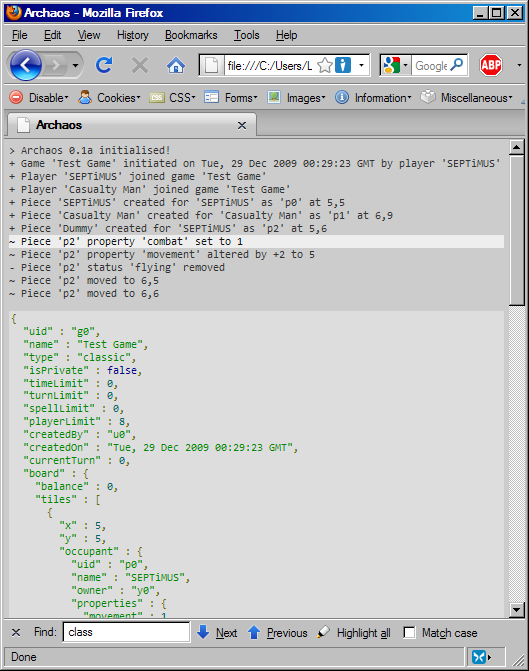
Ahem. Yes, I’ve been beavering away over the last few days and I can finally reveal a proper screenshot of some proper code doing something. Unfortunately, I’ve not started on a client yet, and I’m using a quickly thrown together browser-based console to work with it. However, it is a screenshot, and so I’ll upload it!

One of the fantastic bonuses of writing in Javascript is I have an interpreter with a great debugging suite at my disposal right from the outset with no messing on – Archaos’s core code is designed to run locally in a browser as well as server-side, and an adaptive messaging system will smooth the whole experience out so that what goes in and what comes out is the same wherever the clients or the servers are located.

Website and content © 2009–2026 Lewis Lane