The server is really starting to take shape now. Turns and phases flow along nicely, and I’ve spent the last few days working on the spellcasting system. If you’ve read the Google Code page on Spells you’ll know that the spells themselves are simply sandboxed Javascript functions. I had thoughts before about writing some kind of scripting language for the spells because I wanted maximum flexibility, but it dawned on me that simply giving the spells access to the game and board data themselves in the native language would be the best way to do it. I also not long after that thought about making the validation step the spell goes through beforehand (i.e. where it tells you you can’t cast the spell here, or you can’t cast it on this piece or whatever) in a similar manner, but subsequently rejected it for one very good reason: the clients also need to validate at their end, and they may not be written in Javascript!
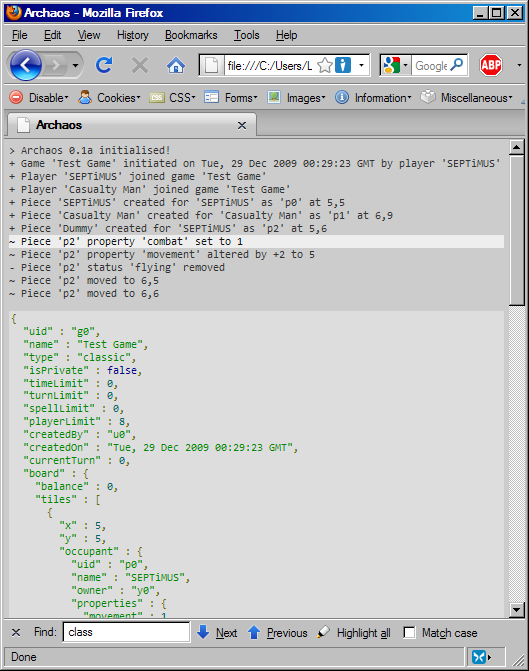
For those interested in creating a client (and because the code isn’t yet ready for viewing!) here’s the current output of a test run on the server. Note that games, pieces and spells have a unique game ID, which is a letter followed by an incrementing numeric value. One of the current things I’m working on is cleaning up the code so all possible references are made to these UIDs, and not directly to the objects, as this will make things safer and more manageable within the engine at the expense of a little bit of performance (no doubt I’ll rewrite much of this at a later date so there are two ‘levels’ of code; the UID data-driven level that the users interact with, and the deeper object-driven stuff that processes things.
{
  "turn" : 1,
  "phase" : "select_spell",
  "interaction" : "all",
  "finished" : true,
  "actions" : [
    {
      "type" : "select_spell",
      "player" : "lewster32",
      "time" : 1262563476,
      "data" : {
        "spell" : "s0"
      }
    },
    {
      "type" : "select_spell",
      "player" : "bobster16",
      "time" : 1262563476,
      "data" : {
        "spell" : "s6"
      }
    }
  ]
}
{
  "turn" : 1,
  "phase" : "cast",
  "interaction" : "sequence",
  "finished" : true,
  "actions" : [
    {
      "type" : "cast",
      "player" : "lewster32",
      "time" : 1262563476,
      "data" : {
        "spell" : "s0",
        "target" : {
          "x" : 0,
          "y" : 1
        }
      }
    },
    {
      "type" : "spawn",
      "player" : "lewster32",
      "time" : 1262563476,
      "data" : {
        "x" : 0,
        "y" : 1,
        "occupant" : {
          "uid" : "p2",
          "owner" : "lewster32",
          "properties" : {
            "movement" : 1,
            "combat" : 7,
            "defense" : 8,
            "maneuver" : 6,
            "resistance" : 4
          }
        }
      }
    },
    {
      "type" : "succeeded",
      "player" : "lewster32",
      "time" : 1262563476,
      "data" : {
        "spell" : "s0",
        "target" : {
          "x" : 0,
          "y" : 1
        }
      }
    },
    {
      "type" : "end_turn",
      "player" : "lewster32",
      "time" : 1262563476
    },
    {
      "type" : "cast",
      "player" : "bobster16",
      "time" : 1262563476,
      "data" : {
        "spell" : "s6",
        "target" : {
          "x" : 11,
          "y" : 1
        }
      }
    },
    {
      "type" : "spawn",
      "player" : "bobster16",
      "time" : 1262563476,
      "data" : {
        "x" : 11,
        "y" : 1,
        "occupant" : {
          "uid" : "p3",
          "owner" : "bobster16",
          "properties" : {
            "movement" : 1,
            "combat" : 6,
            "defense" : 5,
            "maneuver" : 2,
            "resistance" : 4
          }
        }
      }
    },
    {
      "type" : "succeeded",
      "player" : "bobster16",
      "time" : 1262563476,
      "data" : {
        "spell" : "s6",
        "target" : {
          "x" : 11,
          "y" : 1
        }
      }
    },
    {
      "type" : "end_turn",
      "player" : "bobster16",
      "time" : 1262563476
    }
  ]
}
These are what every player will receive at the end of each phase. They contain each action performed by the players in the order that they performed them, and timestamped for reference and backup purposes. Players have relatively limited access to the game in terms of actions, just like in the original game. A player may select spells, cast spells, move and attack pieces and end their turn. From these actions however, more actions may occur, so a player casting a spell on tile x will set off a chain of actions, where the server rolls against the spell’s chance, then (if successful) performs the spell’s effect, which may be to spawn a new piece or whatever.
Soon I’ll be locking down the format of these outputs, and documenting the errors and notices a user receives directly. This will allow for anyone wishing to do so to begin planning or working on a client – and I sincerely hope people do!